April 21, 2026
9 min read
Restaurants miss 32-43% of incoming calls during service. The goal is not fewer phone calls — it is making sure only the calls that need a human get one.
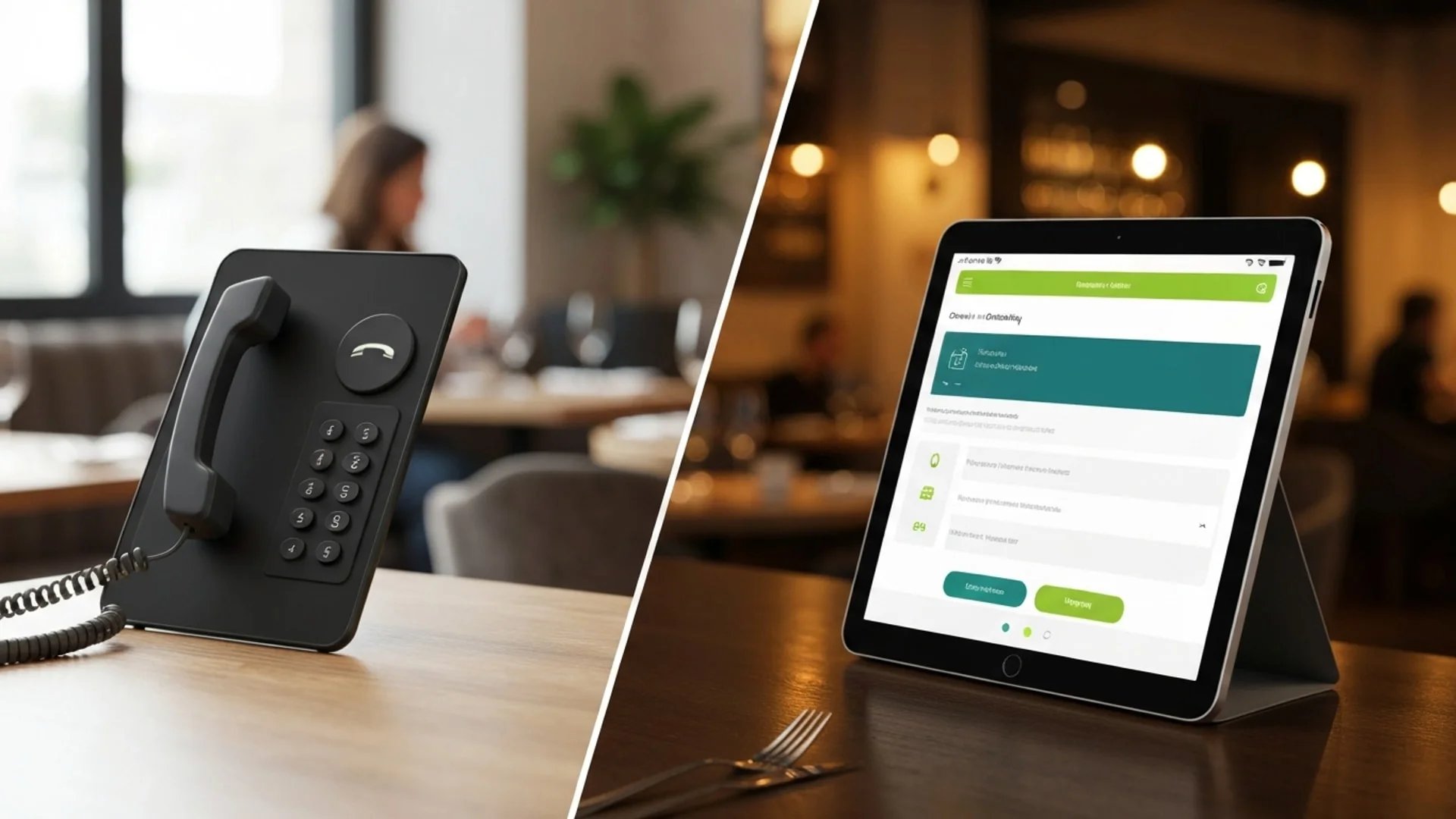
"We have 8 people, one wheelchair user, two vegans, and we are celebrating a 90th birthday. Can you help?"
That is a phone call. No booking widget, however well designed, replaces the human voice confirming that yes, your restaurant can handle it and here is exactly how.
The industry conversation around booking channels has been framed as a migration: phone is legacy, online is the future, and the goal is to move every guest from one to the other. This framing is wrong. It treats phone calls as a problem to eliminate rather than what they often are — your highest-value guest interactions.
The real goal is not fewer phone calls. It is making sure only the calls that genuinely need a human being get one. Everything else should have a faster, better path.
65% of diners go directly to a restaurant's own website to make a reservation, rather than booking through third-party platforms.
Phone reservations still account for roughly 37% of restaurant bookings, with online channels handling 48%.
The shift toward online is real and accelerating. When restaurants activate a new digital channel — Reserve with Google, for instance — bookings increase by a median of 32.3%, with 73% of those coming from first-time guests.
But the shift is not uniform across demographics. 38% of baby boomers still prefer to call, compared to 23% of millennials who prefer app-based booking.
The phone is not dying. It is becoming more concentrated: fewer total calls, but each one is more likely to involve a complex request, a large party, or a guest who needs reassurance before committing.
Here is the uncomfortable part. Restaurants miss between 32% and 43% of incoming calls.
Think about what that means during a Friday dinner service. The host is seating a party of six. The phone rings. Nobody picks up. The caller — a potential booking for next Saturday, a party of four — hears it ring five, six, seven times. They hang up.
Most callers will not try again after a missed call. They book somewhere else or they do not book at all.
At an average party size of three and an average check of EUR 45 per person, each missed-and-lost call costs EUR 135 in potential revenue. Five missed calls on a busy Friday, three of which would have converted: EUR 405. Over a month of Fridays, that is EUR 1,620 — not in discounts or promotions, but in guests who wanted to give you money and could not reach you.
The irony is that most of those missed calls were for standard bookings that did not need a human at all. A party of two, next Thursday, 7 PM. That guest would have happily booked online in 30 seconds — if the option had been obvious, immediate, and friction-free.
Phone bookings are not irrational. They serve real needs.
The birthday party for 12 with dietary restrictions. The wheelchair-accessible table near the entrance. The corporate dinner where the host wants to pre-order wine. These bookings involve back-and-forth that no form can replicate. The guest needs to hear a confident voice saying "yes, we can do that" before they commit.
A first-time visitor to a high-end restaurant. A couple planning an anniversary dinner at a place they have never been. They want to know about parking, dress code, the view from the terrace. The phone call is not about the booking — it is about the decision.
Older guests, people with accessibility needs, those who simply prefer human interaction. A restaurant that only accepts online bookings excludes a meaningful share of potential customers. Accessibility is not a demographic footnote. It is a hospitality obligation.
"Do you have high chairs?" "Can we bring our own cake?" "Is the terrace open in November?" These turn into phone calls because the guest needs context a booking widget cannot provide. They want to book — they just need information first.
These are all legitimate, valuable phone calls. The problem is that they are buried under dozens of routine calls that could have been self-service bookings. When your host is taking a standard two-top reservation by phone at 7:15 PM on a Friday, they are unavailable for the complex request from the birthday party of twelve who just walked in.
A phone booking takes 3 to 5 minutes of staff time. An online booking takes zero.
Over a month with 200 bookings, that is 10 to 16 hours of labour just answering the phone — before you count the calls that do not result in a booking, the callbacks, the messages left on voicemail.
Phone bookings also have higher error rates. Misheard names, wrong dates, forgotten dietary requirements. The guest is not reviewing their own information on a screen. They are relying on the staff member's handwriting, memory, or multitasking ability during a rush.
And there is the double-handling problem. Staff take the booking on paper or in their head, then enter it into the system later. That gap between the paper note and the digital record is where double-bookings happen. We covered this in detail in our article on overbooking prevention.
None of this means phone bookings are bad. It means routine phone bookings — the ones that could have been online — are an expensive way to accomplish something simple.
The solution is not to eliminate phone bookings. It is to make the online alternative so simple that guests who were calling out of necessity now have a better option.
Mobile users abandon forms they find too long — the fewer fields, the higher the completion rate.
The booking widget that works is the one with the fewest steps: pick a date, pick a time, see availability, enter name and phone number, confirm. No account creation. No password. No "sign up to continue." Each added step is a percentage of guests who give up and call instead — or give up entirely.
Mobile matters disproportionately. Most restaurant browsing happens on phones. A booking widget that works on desktop but is clunky on mobile is a widget that generates phone calls.
The confirmation should be immediate. SMS, not just email. The guest should know within seconds that their booking is confirmed. The uncertainty of "did it go through?" is what drives the follow-up phone call that wastes everyone's time.
You cannot eliminate phone bookings. But you can make them more efficient.
Script the essentials. Train staff to capture information in a consistent order: name, date and time, party size, contact number, special requests. Consistent flow cuts a 5-minute call to under 2 minutes.
Enter directly into the system. Never take a phone booking on paper and transcribe later. Enter it while on the call. The guest gets an automatic confirmation SMS, the system updates availability across all channels, and there is no transcription gap where errors enter.
Have availability visible. Staff should see real-time availability while on the call. No "let me check and call you back." No putting the guest on hold while scrolling through a paper diary. The visual timeline shows every open slot immediately.
A complete phone booking — confirmed, SMS sent, availability updated — should take under 90 seconds: "You are confirmed for Saturday at 7 PM, table for four under Williams. You will receive a confirmation text shortly."
You can encourage online booking without alienating guests who prefer the phone.
Voicemail that converts. When guests call during service and reach voicemail: "We are currently serving our guests. Book online anytime at [website], or leave a message and we will call back before noon tomorrow." This converts a significant number of after-hours callers to online bookers without any pressure.
Booking links everywhere. Your Google Business Profile, Instagram bio, Facebook page, printed menus, business cards — every touchpoint should have a direct booking link. Not a link to your homepage. A link that opens the booking widget directly.
Staff mention it naturally. During phone calls: "You can also book anytime on our website — it is the same availability you see here." Not as a redirect. As information.
Track the ratio. Watch your phone-to-online split weekly. Restaurants that add a well-designed online booking system typically see a significant drop in phone calls within the first month. Not because guests stopped wanting to book — because the guests who were calling out of necessity now have a better option.
Track both channels and compare:
Volume split. What percentage comes via phone versus online? Is the ratio shifting? A gradual move toward online means your widget is working.
After-hours bookings. How many online bookings arrive when the phone would be unanswered? This is pure incremental revenue — bookings you would have missed entirely.
No-show rates by channel. Do phone bookings have higher or lower no-show rates than online? If phone no-shows are higher, your confirmation process might need work. If online no-shows are higher, your reminder system might be the gap.
Staff time. How many hours per week does phone booking consume? This is the number that tells you whether your widget is saving labour or whether guests are still defaulting to the phone.
The key to managing phone and online bookings is not choosing one over the other. It is running both through the same system.
When a staff member takes a phone booking, it goes into the same calendar as online bookings. Availability updates instantly across every channel. The phone guest gets the same confirmation SMS as the online guest. The data quality is identical.
Nine Tables handles this by design. Every booking — website, Google, phone entry by staff, walk-in — feeds the same availability engine. The visual timeline shows all bookings regardless of source, so staff always see the complete picture. Phone bookings entered through the dashboard trigger the same automatic confirmations and reminders as online bookings.
The phone is not a separate system. It is a different input method for the same system. That distinction is what prevents the channel conflicts, double-bookings, and data gaps that plague restaurants running parallel systems.
The most successful restaurants do not ask guests to adapt to their preferred booking method. They handle whatever the guest prefers — phone, website, Google, walk-in — with equal quality and zero friction.
The phone will not disappear. But the calls that remain should be the ones worth having: the complex booking, the nervous first-timer, the large party with specific needs. Those conversations are hospitality at its most human. Protect them by making sure the routine bookings have a faster, better path.
That is not a technology problem. It is a design problem. And it starts with asking: which of these calls actually needed a person?