April 7, 2026
10 min read
A restaurant lost 35 of 100 Valentine covers. Large groups spend less per head and sit longer. Here is how to make group bookings pay.
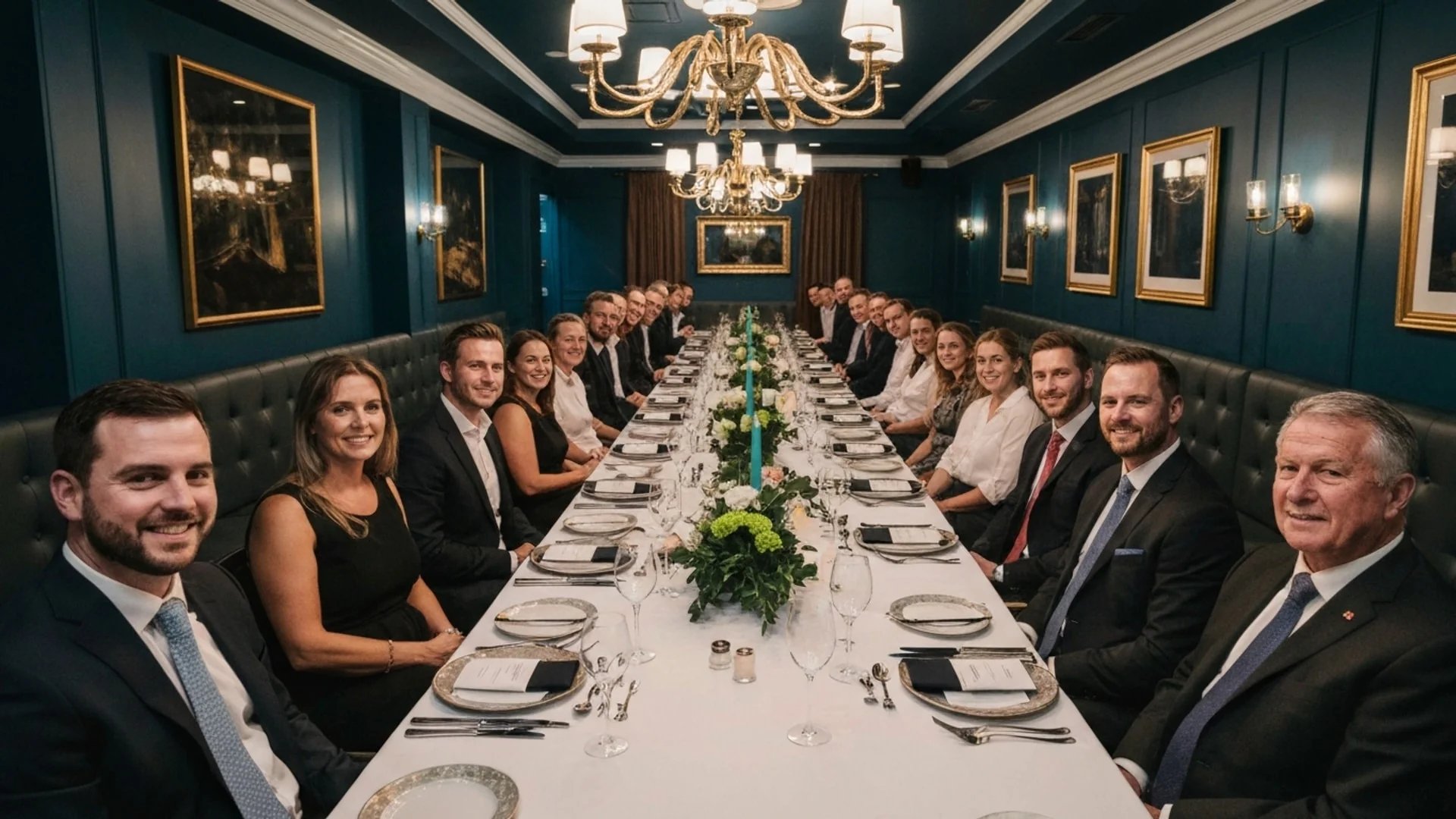
Valentine's Day, 2024. Soleil Ramirez at Crasqui in Saint Paul had 100 reservations on the books. Only 65 covers showed up.
Thirty-five empty seats on the most profitable night of the year. The food was prepped. The staff was scheduled. The revenue was gone. She escalated her deposit from $25 to $40 per person after that night.
That story captures the central tension of large group bookings: they look like guaranteed revenue on the books, but they carry risks that smaller reservations do not. Understanding the actual economics -- and building systems around them -- is what separates restaurants that profit from groups and restaurants that dread the phone call.
The instinct is that bigger tables mean bigger revenue. The data says otherwise.
Compared to smaller parties, larger parties take longer to dine and spend less per person. A Cornell study published in the Journal of Service Research found that 17% of restaurant managers actively restrict or discourage parties of six or more. For parties of seven and above, managers overestimate wait times as a deterrent to avoid seating them at all.
That behaviour exists for a reason. Large groups order more conservatively. They share dishes. They spend longer at the table, which means fewer seatings in the same time slot. And when a large group does not show, the financial damage is not proportional -- it is exponential.
As Felicia Wilson from Amina Restaurant in Philadelphia put it: "You are losing revenue each way." The table sat empty, and you turned other guests away to hold it.
Consider a 70-seat restaurant on a Friday evening. A group of 14 requests a reservation. You need to combine four 4-tops to seat them. Here is the calculation.
Scenario A: Four separate 4-tops across the evening
Scenario B: One group of 14, single seating
The group booking generates EUR 756 less from the same physical space. Factor in the longer kitchen ticket times, the additional server attention, and the risk of a no-show that wipes out all four tables at once, and the gap widens further.
This does not mean you should refuse groups. It means you should price and protect them differently.
The Pennsylvania Restaurant and Lodging Association recommends deposits of $25-100 per person for groups of six or more.
The range is wide because the right amount depends on your price point and your no-show history. But the principle is not negotiable. A no-show for a table of two is a minor annoyance. A no-show for a table of 14 -- where you turned away three other parties to hold the space -- can affect your entire week.
The data on deposit effectiveness is clear. One reservation platform's analysis of bookings from December 2023 to March 2024 found a 0.9% no-show rate with full prepayment and 1.7% with deposits -- a fraction of what restaurants without either policy typically experience.
The amount matters. Oxeye Restaurant in the UK experimented with different levels. At a GBP 50 per-person deposit, they had zero no-shows. When they lowered it to GBP 5 per person, they had their first no-show within a week.
The deposit needs to be high enough that it represents a real commitment. For a detailed breakdown of cancellation policies and deposit structures, see our guide to cancellation policies that work.
A set menu for large groups is not about limiting choice. It is about controlling three variables simultaneously: food cost, kitchen load, and service speed.
Amanda Cohen of Dirt Candy in New York City switched to a prix fixe format and saw her food costs drop from 26% to 12%. "I know exactly how much food to order now, the format saves time and labor, and there is no waste," she said.
For large groups specifically, prix fixe eliminates the problem of 14 people ordering from the full menu with different courses arriving at different times. The kitchen can batch prep, fire courses together, and the table eats as a group rather than in awkward waves.
Offer two or three choices per course. Cover the major dietary needs. Send the menu options by email when the booking is confirmed, with a deadline 48 hours before the reservation. This gives you time to prep accurately and gives the group time to coordinate without the chaos of tableside decision-making.
There is a scientific explanation for why group dining behaves differently than small-party dining. A 2019 meta-analysis published in the American Journal of Clinical Nutrition found that eating with familiar others has a powerful effect of increasing food intakes.
People eat more when they dine with people they know. Meals last longer. The social dynamic changes ordering behaviour -- more shared plates, more courses, more drinks. This is the upside of group bookings. While per-person entree spend may drop, total spend on drinks, shared starters, and desserts can increase. A prix fixe menu with optional drink pairings captures this behaviour instead of fighting it.
The tipping dynamic is worth understanding too. Research going back to Freeman et al. in 1975, confirmed by Lynn and Latane in 1984 across 396 groups, found that tip percentage is an inverse power function of group size. The larger the group, the lower the per-person tip -- not because of bad service, but because of social diffusion. Each person assumes someone else is contributing generously.
This is why an automatic service charge for groups above a certain size protects your staff without creating conflict. Set it at booking time, communicate it clearly in the confirmation, and it becomes a non-issue.
If your restaurant has the space, private and semi-private events represent a different category entirely. According to FSR Magazine, private event margins run 15-25%, compared to 3.5-8% for standard table service.
The economics flip because private events come with minimum spends, set menus, and advance payment. The uncertainty that makes standard group bookings risky is removed by structure.
Platform data from one event management provider shows $8.4 billion in event revenue processed in 2024, with an average of $70 per person and $3,000 per event.
Even without a dedicated private dining room, a semi-private area -- a corner screened by plants, a mezzanine, a back section that can be curtained off -- can serve the same function. The key is framing it as a private dining experience rather than just a big table. That framing justifies the minimum spend and the set menu.
One practical concern that restaurants underestimate: a group of 14 celebrating will change the atmosphere for every other table in the room.
SoundPrint measured the average restaurant noise level at 78.1 dBA, with 66% of restaurants too loud for normal conversation.
A large group pushes that number higher. If you seat a birthday party in the middle of the dining room, the couple on an anniversary dinner two tables away will notice. Their experience suffers, and they did not choose to dine next to a party.
Position groups strategically. Use separate sections, back rooms, or corners with natural sound barriers. If your space does not have a separate area, consider time-based separation -- seat the large group at 18:00 or 21:00 when the dining room is less full, rather than at peak 19:30 when every table is occupied. For a deeper look at managing Friday night capacity, see our peak hour management guide.
When we built the group booking flow in Nine Tables, we started from one observation: the problem is not that groups are hard to manage. The problem is that most booking systems treat a party of 14 the same as a party of 2 -- same booking form, same confirmation, same policies.
We built a threshold system. Above a configurable party size, the booking flow changes. Deposit requirements appear. Pre-order options become available. The floor plan shows which table combinations work and how the group affects surrounding seatings. The confirmation includes the cancellation policy in plain language.
The design tension was between automation and conversation. A fully automated system is efficient but impersonal for a group booking that might involve a birthday, a corporate event, or a family reunion. A fully manual process (call or email for groups over 8) is personal but creates friction and delays. We landed on a middle path: automate the booking and policies, but give the restaurant the option to route large groups to a direct inquiry instead of instant confirmation. The restaurant decides where the line is.
The floor plan visualization turned out to be more useful than we expected. Seeing the spatial impact of a group booking -- which tables combine, which adjacent tables are affected, how the server sections shift -- changes the conversation from "can we fit 14?" to "where do 14 make the most sense tonight?"
The restaurants that do well with large groups share a pattern. They do not treat groups as regular bookings that happen to be bigger. They treat them as a distinct category with its own pricing, policies, and preparation.
The checklist is straightforward:
That last point is the one most restaurants skip. Track it. Run the math for your specific restaurant. You may find that groups of 8-10 are your sweet spot but groups above 14 cost you money without a minimum spend. The data behind your no-show patterns and table utilization numbers will tell you where the line is.
Large group bookings are not inherently good or bad revenue. They are a category that rewards preparation and punishes improvisation.