January 7, 2025
8 min read
Guests who are acknowledged within 10 seconds report 30% higher satisfaction. Loyal customers spend 67% more. The arrival is the highest-ROI moment in your restaurant.
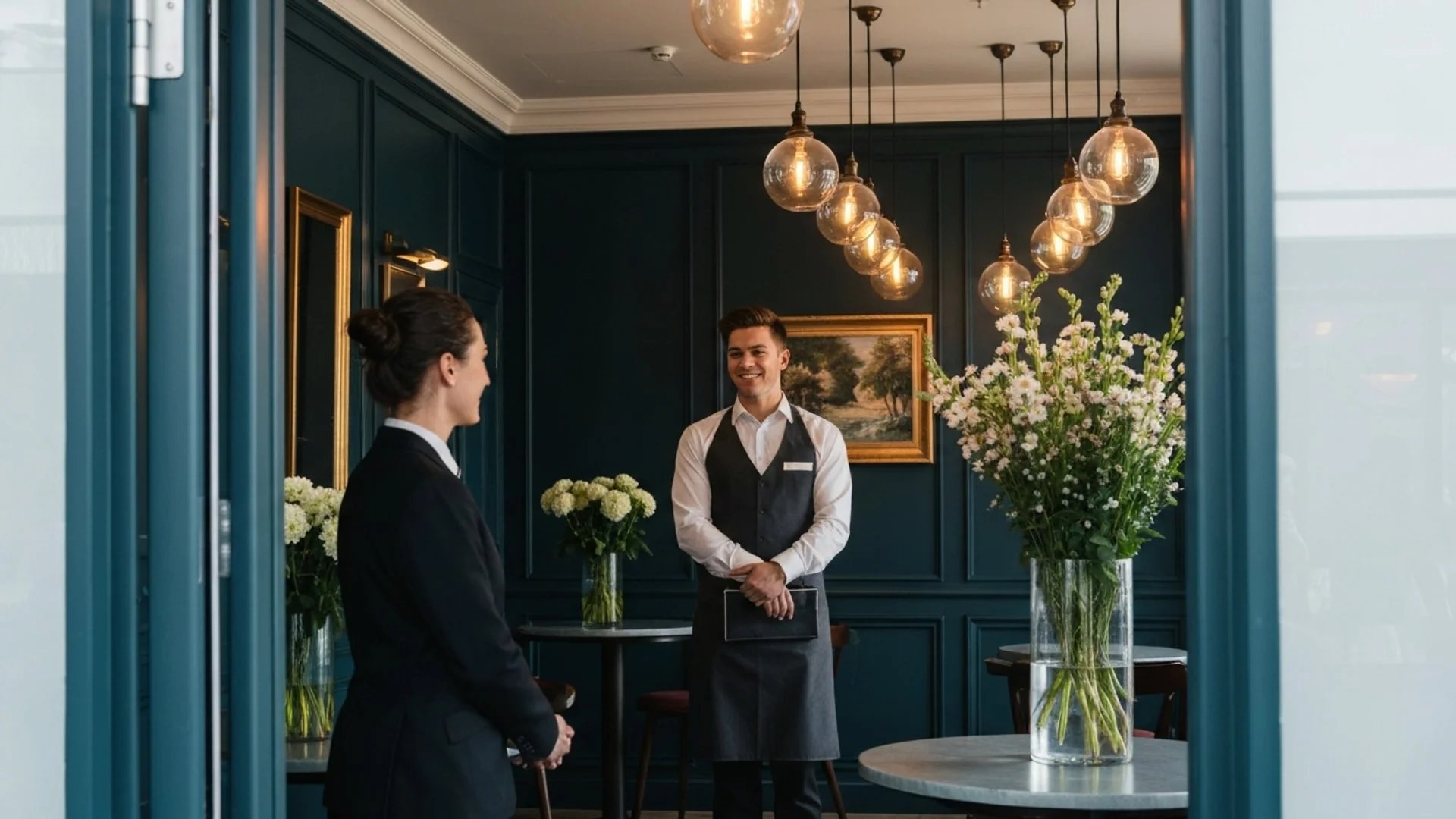
The first five minutes determine everything.
Guests who feel welcomed at arrival enjoy their meal more. They rate food higher. They tip better. They return more often. They recommend you to friends. Research in hospitality psychology consistently shows that the arrival experience has an outsized impact on the overall dining evaluation -- more than food quality, more than ambiance, more than price.
Loyal customers spend 67% more at restaurants than new ones, according to Bain & Company research.
A perfectly cooked steak does not undo the feeling of standing at the door for three minutes while staff walk past without acknowledgment.
When guests arrive, they are in a psychologically vulnerable state:
A warm, confident greeting resolves uncertainty instantly. A fumbled or absent greeting confirms their worst fears.
Guests who receive acknowledgment within 10 seconds of entering report 30% higher satisfaction rates, regardless of subsequent wait times.
The window for making a first impression is measured in seconds, not minutes.
Guests should be acknowledged within three seconds of entering. Not necessarily seated. Not necessarily by the person who will help them. Just acknowledged.
"Welcome, we will be right with you."
That is enough. It says: we see you, we expect you, you are in the right place. Silence says the opposite. The human need to be seen and acknowledged is primal. Meeting it costs nothing -- a glance, a smile, a brief sentence. Failing to meet it costs everything.
The difference between a restaurant with a good reservation system and one without is most visible at the moment of arrival.
When your host has the evening's reservations on screen, they can match faces to names. A guest walks in, says "reservation for Thompson," and the host immediately sees: party of 4, arriving at 19:30, table 12 by the window as requested, anniversary dinner, one guest has a shellfish allergy, returning guest on their third visit this year.
Compare that to a host flipping through a paper book, squinting at handwriting, and saying "Thompson... let me check..."
With a visual floor plan, tables are assigned before guests arrive. The host does not scan the room, weigh options, or make guests wait while figuring out where to seat them. The table is chosen, the server is alerted, and the path from door to seat is smooth.
When a guest noted "wheelchair accessible seating" or "high chair needed" during booking, that information is right on the screen when they arrive. No awkward questions. No scrambling. The request is already handled.
For returning guests, stored preferences and past visit data make personalised greetings possible. When the host sees "prefers booth seating" or "regular -- usually orders the tasting menu," they can personalise without the guest repeating themselves.
When a guest with a reservation is greeted by name, something fundamental shifts.
"Good evening, Ms. Johnson, welcome back."
That single recognition transforms the experience from anonymous transaction to personal relationship. The guest feels known. Expected. Valued. Hearing your own name activates unique brain patterns associated with self-identity and emotional engagement.
A name used three times during the evening -- at arrival, during service, and at farewell -- creates a fundamentally different experience than one where the guest is never addressed personally.
The host stand is your front line. What guests encounter there shapes everything that follows.
Signs of excellence:
Warning signs:
The best hosts make it look effortless. That ease comes from good systems providing instant information, clear training on what to say and do, and genuine hospitality.
Sometimes guests wait. How you handle it matters as much as the wait itself.
When the table is not ready:
The key insight: waiting itself is not bad. Not knowing is bad. A guest who knows they will wait 10 minutes is relaxed. A guest with no idea if it will be 2 or 20 is anxious.
A Harvard Business School study found that a one-star increase in Yelp rating leads to a 5-9% increase in revenue. Arrival experience directly affects those ratings.
The gap between host and server is where many restaurants lose momentum. The guest is seated, the host walks away, and then nothing. Two minutes pass. Five minutes. The initial warmth evaporates.
A smooth handoff:
The guest should never feel abandoned between host and server. If there will be a delay, the host should say so.
If the booking notes a birthday or anniversary, the arrival is your first chance to acknowledge it:
"Happy anniversary -- we are so glad you chose to celebrate with us."
People do not celebrate at restaurants every week. When they do, they remember every detail. A restaurant that acknowledges the occasion from the moment of arrival becomes part of the memory. That is powerful loyalty.
Sometimes arrivals fail. A reservation is lost. The table is double-booked. There is an unexpected delay. How you recover matters more than the mistake itself.
A fumbled arrival that is gracefully recovered can actually strengthen loyalty. "They made a mistake, but they handled it beautifully" is a story guests tell friends.
Nine Tables surfaces everything the host needs at the moment of arrival: guest name, party size, table assignment, special requests, dietary needs, occasion notes, and visit history. The visual floor plan shows table status at a glance. Pre-assigned tables eliminate decision-making at the stand.
For returning guests, the guest profile displays preferences and past visits -- enabling the kind of personalised welcome that turns first-time visitors into regulars.
A perfect arrival costs almost nothing: a smile, a name, eye contact, smooth systems, a genuine welcome. But the return is substantial. Guests who feel welcomed at arrival rate their overall experience significantly higher. They return. They recommend. They leave the kind of reviews that bring new guests through the door.
Those first five minutes are the highest-return investment you can make. And the tools that support them -- a system that surfaces guest information, assigns tables in advance, and tracks special requests -- make excellence repeatable, not accidental.
Every guest who walks through your door is hoping for a good experience. Meet them at the door with their name, a smile, and the confidence that comes from being prepared.